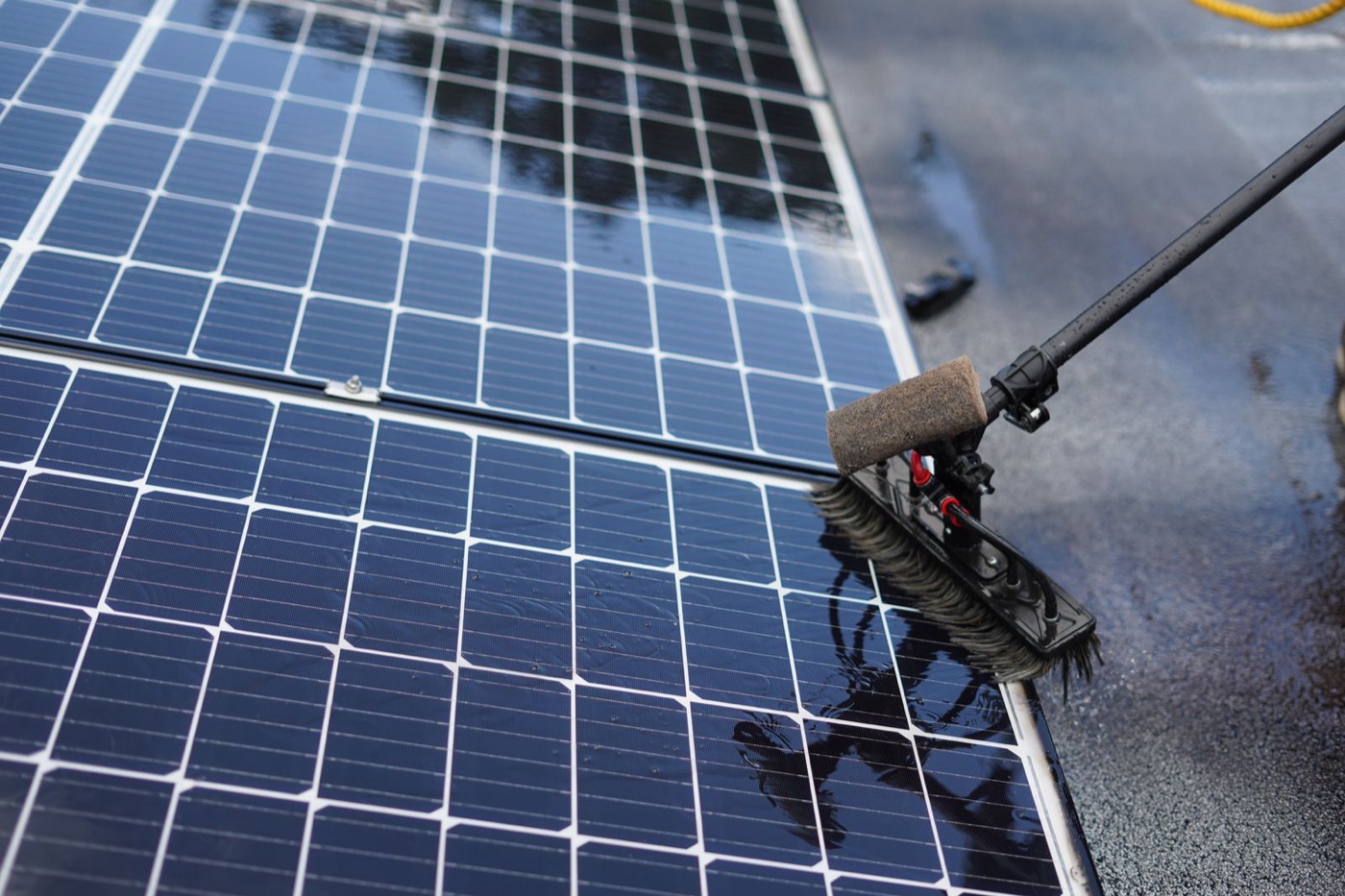
Why dirty panels cost you
Dust, pollen and grime silently drain 7–15% of a plant's daily power. In India's dusty farm and factory belts, panels can get dirty within days. Manual cleaning is irregular, costs labour and uses a lot of water. Cleaning robots add machinery that can fail, and brushes touch the panel surface and can scratch it over time.
How Aran cleans your panels
Instead of a separate machine, the cleaning is built into the solar structure:
- High-pressure water nozzles are fixed into the structure, facing the panels.
- On a set schedule, they spray the panels clean — no brushes, no contact, no scratching.
- The water is collected below, filtered and reused in a closed loop; the structure can also channel rainwater into the same system.
- Your panels stay clean on their own, at almost no ongoing water or labour cost.
Illustrative default values — request a site-specific quotation.
What you get
~7–10% more power
Consistently clean panels recover the power that dust quietly takes away.
No brush damage
Nothing touches the panel surface, so there's no scratching or abrasion.
Water reused
Closed-loop recovery and rainwater harvesting — workable even where water is scarce.
No cleaning bill
Almost no ongoing labour or water cost — a big saving over 25 years.
Built-in fire safety
Pressurised water across the array is ready to douse an electrical or heat fire.
No robots to maintain
No separate cleaning robot to buy, charge, store or repair.
Everyone else says waterless. Why do we use water?
It is the first question anyone asks, and it deserves a straight answer rather than a sales one.
Most automated cleaning sold in India today is a waterless robot — a machine that sits on the array and sweeps the panels dry with a brush or microfibre roller. The argument for it is a good one: solar plants are built where land is cheap and water is scarce, so a system that needs no water at all removes a real problem.
We took a different route, and here is the honest trade-off.
A waterless robot is a machine, and machines fail. It needs rails to travel on, a charge, servicing, and spares held somewhere. There is typically one per row or per array, so a large plant is buying and maintaining a fleet. When one stops, that row simply stops being cleaned, and nobody notices from the gate — the same quiet failure that costs plants their tracker gain.
Our system has no separate machine. The nozzles are built into the structure the panels already sit on. There is nothing to charge, nothing to drive along a rail, and nothing that can seize halfway down a row. The water is caught below, filtered and recycled in a closed loop, so the plant is not consuming fresh water every wash.
There is a second reason, and it is the one that matters most to us: our panels move. Putting a rail-guided robot on a row that rotates through the day is a harder engineering problem than putting one on a fixed array. Because our nozzles are part of the tracker structure, they move with it.
When a waterless robot is the better choice
If your site genuinely has no water — no borewell, no canal, no tanker access you can rely on — then a waterless robot is the right answer and we will tell you so. A closed loop still needs water to start with and topping up for what evaporates. We would rather lose that enquiry than sell you a system your site cannot feed.
For most plants in Tamil Nadu the question is not whether water exists, but whether anyone is going to keep cleaning with it. That is the problem we set out to solve.
Waterless robots vs Aran water jets
Illustrative default values — request a site-specific quotation.
Honest note
Our automated cleaning system is currently in its testing phase. Talk to us about your site and we'll tell you exactly what's ready for your project today — and how cleaning fits with the Aran tracker.
Best paired with the tracker
The cleaning system is built into the same structure as the Aran solar tracker, so you get both the tracker's power gain and consistently clean panels from one setup. See the solar tracker →
Common questions
How does automated solar panel cleaning work?
Aran builds high-pressure water nozzles directly into the solar structure. On a set schedule they spray the panels clean — no external machines, no brushes and no contact with the panel surface. The water is collected below, filtered and reused in a closed loop, so very little water is lost.
Why water, when everyone else sells waterless robots?
A waterless robot is a machine per row that needs rails, charging, servicing and spares — and when one stops, that row quietly stops being cleaned. Aran's nozzles are built into the structure the panels already sit on, so there's nothing to charge or drive along a rail, and they move with the tracker. The water is caught, filtered and recycled in a closed loop. If your site has no reliable water at all, a waterless robot is the better answer and we'll say so.
How much extra power do clean panels give?
Dust and dirt can quietly cut 7–15% of a plant's daily power. Keeping panels consistently clean recovers much of that — about 7–10% more power in typical conditions. Figures are illustrative; ask for a site-specific estimate.
Does it use a lot of water?
No. The cleaning water is collected, filtered and reused in a closed loop, and the structure can channel rainwater into the same system. This makes it workable even where water is scarce.
Is the automated cleaning system available now?
The automated cleaning system is currently in its testing phase. Talk to our team about your site and we'll tell you exactly what's available for your project today.
Ask about automated cleaning for your plant
Tell us about your site and we'll come back with how automated cleaning fits — and an illustrative estimate of the power and cost it can save. No obligation.
Thanks — we've got your details and will get back to you soon.
Message us on WhatsApp now